
Does Antarctica matter more here than anywhere else?
I live in Punta Arenas, Chile — one of the five Gateway Cities to Antarctica. Here, the continent isn't an abstract, distant place. It's the view from my window, the name of my region, the reason cruise ships and research vessels pass through town every summer.
Living here, I started to wonder something: does Antarctica actually get talked about more in a city like this — online, in real search behavior — than anywhere else in the world? Or is that just a feeling locals like me carry around, without any real evidence behind it?
That question became a research project. Over the past several months, I used five years of Google Trends data to track how the word "Antarctica" gets searched — not just in Punta Arenas, but across all five Gateway Cities (Ushuaia, Hobart, Christchurch, and Cape Town), and compared against five major world capitals with no particular connection to the continent at all.
The short answer: yes, Antarctica does matter more here. But not in the way I expected.
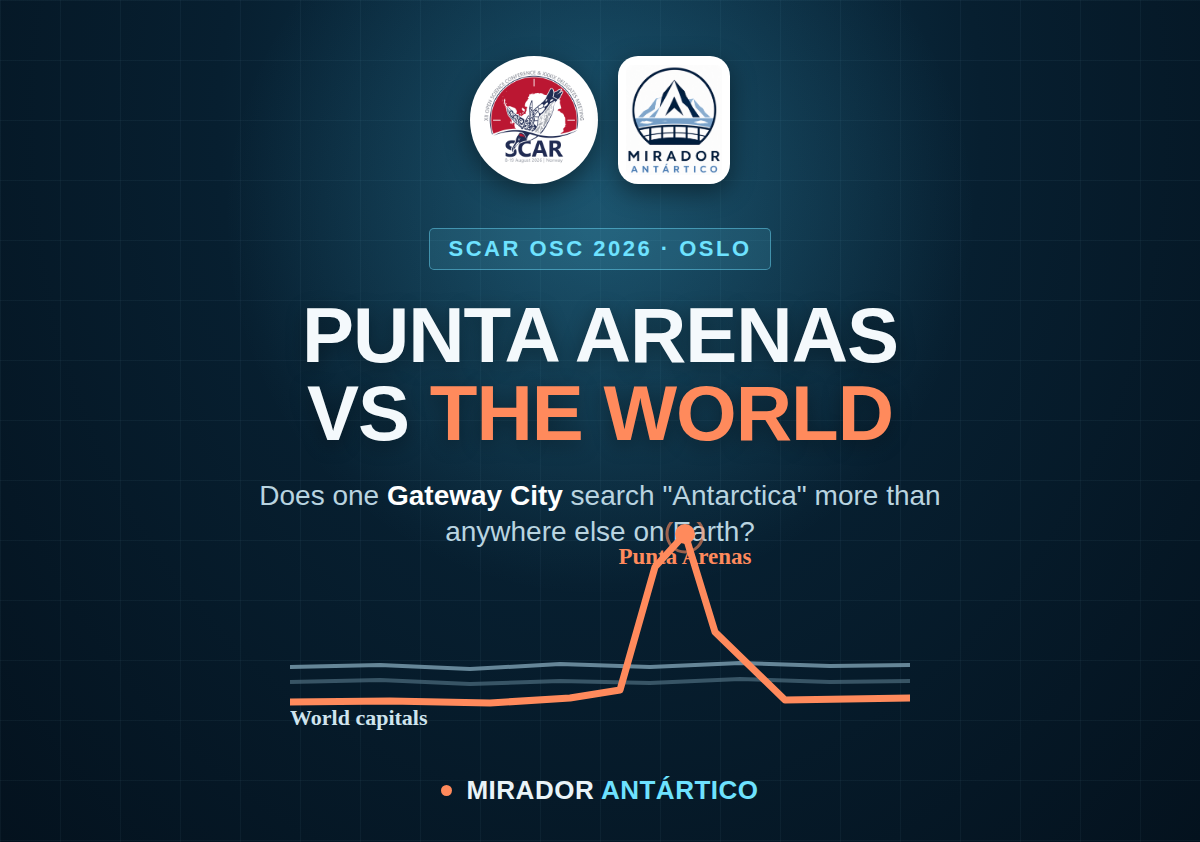
Global capitals show a constant, low-level curiosity about Antarctica — present almost every week, but never particularly intense. Punta Arenas, on the other hand, goes silent for months at a time, and then spikes to levels no global capital ever reaches — usually when something actually happens. A pilot lands without permission. A ship makes a historic flight. A story catches fire, and for a few weeks, this city searches for Antarctica like nowhere else on Earth.
I also found that language changes everything. The same event, the same city, produces completely different search patterns depending on whether people are searching in Spanish or in English — almost like two different audiences living in the same place, rarely crossing paths.
Below, you'll find the three pieces that came out of this project:
The paper — the full academic write-up, with the complete methodology, data, and findings, prepared for the SCAR Open Science Conference 2026 in Oslo and for a forthcoming book chapter with the Centro de Estudios Hemisféricos y Polares.
The poster — a condensed visual summary of the same research, presented digitally at SCAR OSC 2026.
The video — a short, informal walkthrough of the project and its main findings, in my own words.
If you're curious about how a place shapes — or doesn't shape — what its people search for online, I hope this gives you something to think about.
Data processing for this project was supported by Claude (Anthropic), used as a systematization and exploratory analysis tool. Research design, verification, and writing are the author's own.