
María Pastora Sandoval Campos, MA.
Punta Arenas, Ushuaia, Hobart, Christchurch and Cape Town are the five Gateway Cities: the only cities in the world recognized as human access points to the white continent. Each one earned that role through a different path — tourism, science, logistics, identity — and that difference also shows up in something as simple as what their residents type into a search bar.
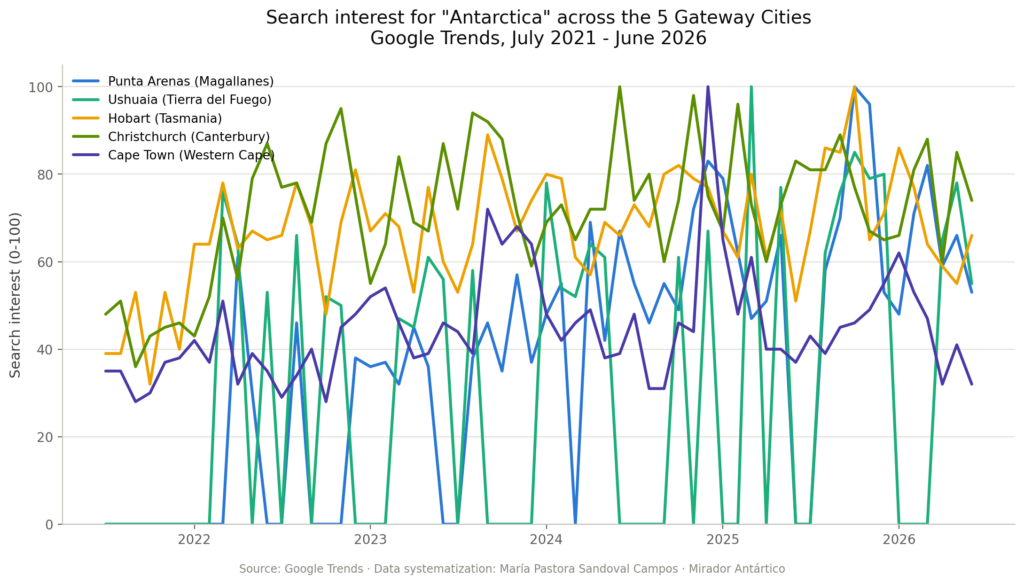
We analyzed five years of Google Trends data (July 2021 to June 2026) for the word "Antarctica" — and its equivalents by language and country — in each of these five cities. The result: none of them look quite like the others.
Punta Arenas: between institutional pride and a stranded influencer
In Magallanes, the top search isn't "Antarctica" on its own, but "Antártica chilena" (Chilean Antarctica). People search for the official regional name. That already says something: here, the bond with the white continent is administrative, everyday, part of the region's own name.
The highest point of search interest in the last five years happened in October and November 2025. The reason has a name: Ethan Guo, the American pilot and influencer who landed without authorization in Chilean Antarctica on June 28, 2025, and ended up stranded for nearly two months at Frei Base before he could return to Punta Arenas. His plane, for what it's worth, stayed stuck in the ice much longer — it wasn't recovered until February 2026.
Here's the interesting part: when we run the same search in English, the peak shifts to a different month. It shows up in January and February 2026, matching the case's international resolution and, not coincidentally, the peak of cruise season. Same event, two different audiences, two different moments.
Ushuaia: the most seasonal city of the five
If one Gateway City lives and dies by the cruise calendar, it's Ushuaia. Searched in English, the curve is nearly a flat line at zero between April and October, then spikes without exception between November and March. No city in the study is more seasonal.
In Spanish ("Antártida", Argentina's official term), the pattern looks completely different: far more irregular, with no clear seasonality, and vocabulary centered on institutional terms ("Antártida argentina", "Argentine bases in Antarctica"). It's almost like looking at two different cities, depending on which language you ask in.
Hobart and Christchurch: the scientific ones
Tasmania (Hobart) and Canterbury (Christchurch) share something none of the other regions have: active searches all year round, with no off-season. That tracks — both are permanent seats of national Antarctic programs (the Australian Antarctic Division and Antarctica New Zealand), with real job postings and stations running twelve months a year.
Christchurch's most striking peak happened in the depths of the austral winter, in June 2024, when the New Zealand Air Force carried out an emergency medical evacuation from Antarctica under extreme conditions. In Hobart, the peak landed in October 2025, matching the start of the science season: Australian aircraft and icebreakers resupplying Casey and Davis stations.
Cape Town: the loneliest peak of them all
Of the five cities, Cape Town has the sharpest, most isolated spike: December 2024, far above any other month in the series. The cause was a historic flight: an Airbus A340 took off from Cape Town for the private ice runway at Wolf's Fang, operated by tourism company White Desert, and went viral online.
One more detail sets Cape Town apart: its most repeated search isn't a place name or a brand, but a basic question — "what is antarctica". No other Gateway City has anything like that as its top search, a sign of an audience with less prior familiarity with the continent than in the other four cities.
The takeaway: language matters more than the city
The most curious finding of the whole study isn't about any single city — it's about language. When we compare English-language searches from Punta Arenas and Ushuaia — two cities more than 800 kilometers apart, in different countries — they turn out nearly identical: same seasonal pattern, same cruise-and-tour-operator vocabulary.
But when we compare the Spanish-language versions of those same two cities, they don't resemble each other at all. Each has its own rhythm, its own institutional vocabulary.
The simplest explanation: the language someone searches in reveals who they are. An international tourist searches for almost the same thing whether they're thinking about Punta Arenas or Ushuaia. A local resident searches for something entirely different — and that something does change from city to city.
This analysis is part of an ongoing research project that will be presented as a poster at the SCAR Open Science Conference 2026, in Oslo.
Note: the processing and systematization of the Google Trends data for this article was supported by artificial intelligence (Claude, by Anthropic), used as an exploratory analysis tool. The research, journalistic verification and writing are the author's own.